Best uses
- Convert base-10 values into base-8 notation.
- Practice number systems for programming or computer science.
- Check examples related to permissions or older computing systems.
Convert decimal numbers to octal online, read remainders upward, and review examples, invalid octal digits, FAQs, and conversion checks.
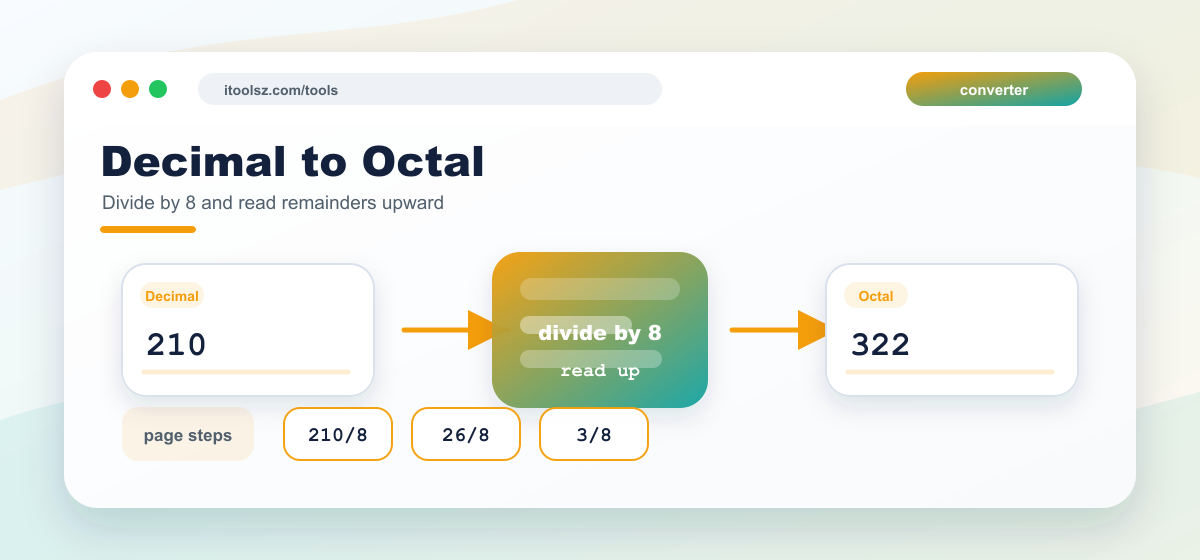
To convert the whole-number part of a decimal value to octal, divide by 8 and read the remainders in reverse order. For the fractional part, multiply by 8 repeatedly and record each whole-number result until the fraction becomes 0 or reaches the precision you need. The example below shows the process:
(210.625)10 = (?)8
| Divided by 8 | Quotient | Remainder | Flow |
|---|---|---|---|
| 210 / 8 | 26 | 2 | ↑ |
| 26 / 8 | 3 | 2 | ↑ |
| 3 / 8 | 0 | 3 | ↑ |
| Multiply by 8 | Result | Non-Fractional Part | Flow |
|---|---|---|---|
| .625 * 8 | 5.00 | 5 | ↓ |
Decimal to octal conversion is useful for learning base systems and for reading examples where values are grouped by powers of 8. You may still see octal in file permission examples, older computing material, and number-system exercises where binary values are grouped into sets of three.
| Decimal | Octal |
|---|---|
| 0 | 0 |
| 1 | 1 |
| 2 | 2 |
| 3 | 3 |
| 4 | 4 |
| 5 | 5 |
| 6 | 6 |
| 7 | 7 |
| 8 | 10 |
| 9 | 11 |
| 10 | 12 |
| 11 | 13 |
| 12 | 14 |
| 13 | 15 |
| 14 | 16 |
| 15 | 17 |
| 16 | 18 |
| 17 | 19 |
| 18 | 20 |
| 19 | 21 |
| 20 | 22 |
Repeated division by 8 gives the octal whole number directly: keep each remainder and read the remainders from the final division upward. You can verify the same result by converting the decimal value to binary and grouping bits in threes from the radix point. Agreement between the two methods is a useful way to catch a reversed remainder or a copied digit.
Digits 8 and 9 can appear in the decimal input but never in the octal answer. Fractional values use repeated multiplication by 8, and some expansions do not terminate. Preserve the requested number of octal places, state when rounding was used, and convert the rounded result back to decimal when accuracy matters.
Decimal to octal conversion uses repeated division by 8. The remainders, read from bottom to top, become the octal number.
Octal is base 8, so its digits are only 0 through 7.
210 in decimal is 322 in octal.